Building a Single Source of Truth:
The Founder’s Guide to an Operations Manual That Actually Gets Used
Almost every growing company has some version of an Operations Manual attempt buried in a Google Drive folder somewhere. A half finished document, started with good intentions, abandoned around page three, never opened again by anyone.
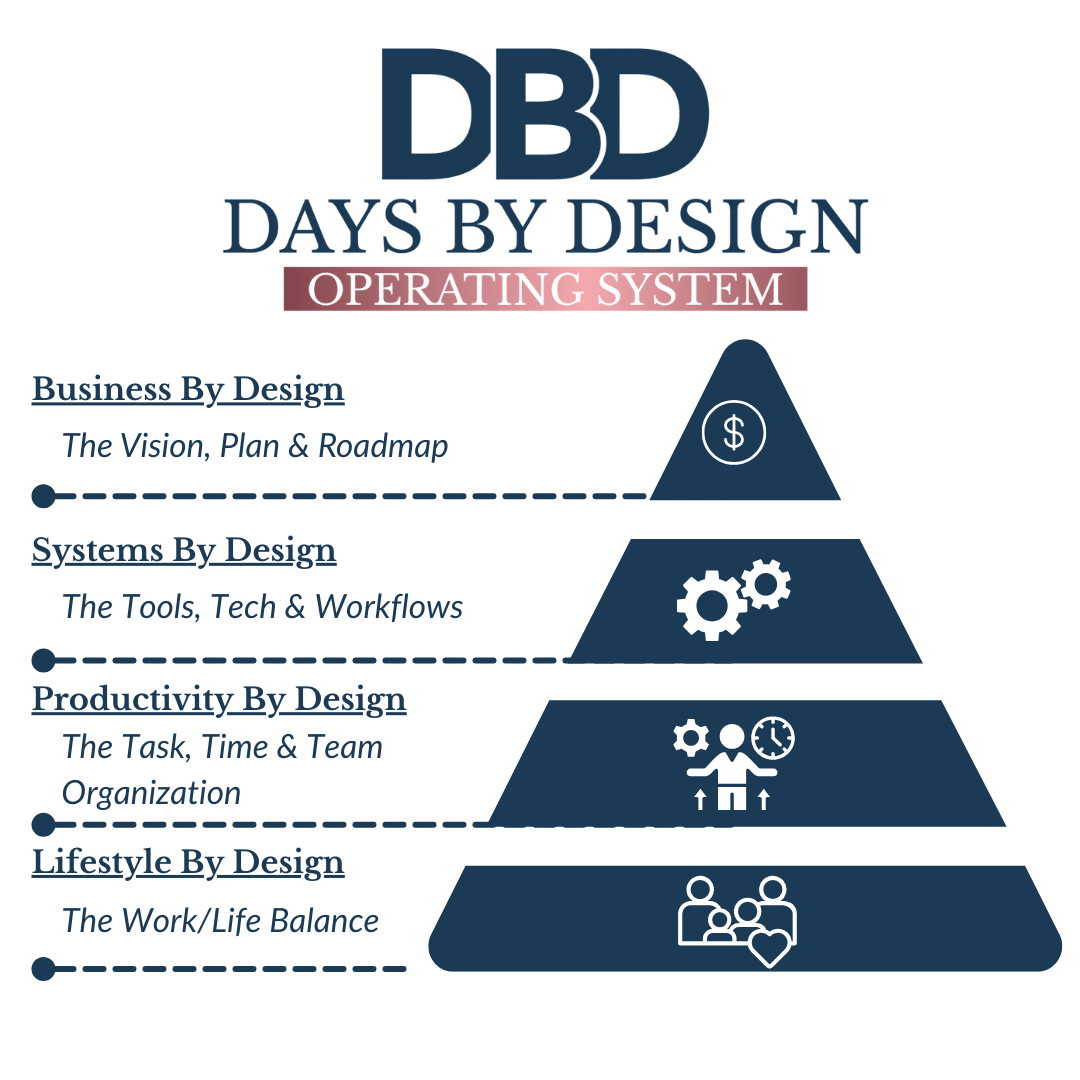
The problem is rarely motivation. It is structure. Founders sit down to write everything at once, the project feels endless, and it dies under its own weight before it ever becomes useful. Inside the Days By Design Operating System™, we build Operations Manuals differently, using a structure that makes the project finishable and, more importantly, makes it something your team actually opens.
Here is the exact process.
Step One: Organize Around the BCO Method
Before writing a single SOP, set up three top level categories. Business Development, which covers sales, marketing, and how new business moves through your pipeline. Client Services, which covers onboarding, fulfillment, and offboarding. Operations, which covers the backend functions that keep the company running: finance, admin, HR, IT, legal. Every piece of company knowledge sorts into one of these three buckets. This structure alone turns an overwhelming, undefined project into three clear, bounded sections.
Step Two: Start With Repeated Questions, Not a Blank Page
Do not start by trying to document everything. Start by tracking every question your team asks you more than once over a two week period. These repeated questions are proof of demand. They tell you exactly which five to ten entries will deliver immediate value the moment they are written, instead of guessing at what might matter someday.
Step Three: Write for the Newest Team Member, Not for Yourself
The biggest mistake founders make writing SOPs is writing them at their own level of context. You know things your team does not, and if you write assuming that shared context, the document will confuse the exact person who needs it most. Write every entry as if the newest hire, with zero background, is the one reading it for the first time.
Step Four: Make It Searchable, Not Just Written
A document nobody can find is functionally the same as a document that does not exist. Whatever tool you choose, whether it is Notion, Google Drive, or a dedicated wiki tool, the manual needs to be searchable by keyword, organized with a clear table of contents, and linked from wherever your team already works daily. If finding an answer takes longer than asking you directly, your team will keep asking you directly, no matter how much content you have written.
Step Five: Build a Maintenance Rhythm
An Operations Manual is not a one time project. Processes change, tools change, teams change, and a manual that goes stale becomes actively dangerous, because people start following outdated instructions with full confidence. Build a standing quarterly review into your calendar where someone is responsible for checking that every entry still reflects how the business actually operates today.
Why This Actually Matters for Scale
An Operations Manual is not a nice to have for growing companies. It is one of the clearest signals of whether a business can scale past its founder. A company that runs entirely on the founder’s memory has a hard ceiling, because growth requires more people making more decisions, and people cannot make good decisions without access to good information.
The founders who build this well are not necessarily the most organized people. They are the ones willing to treat documentation as core infrastructure, not an eventual nice to have squeezed in whenever there is spare time, which for most founders is never.
Start with your five most repeated questions this week. Write them for someone with zero context. Make them searchable. That is the entire beginning of a source of truth that will save your company hundreds of hours over the next year alone.
Book a call or send me a DM to learn more.