The Hidden Cost of Digital Chaos: Why Your Workspace Is Limiting Your Company’s Growth
Most founders do not wake up one morning and decide to build a chaotic company.
Chaos happens slowly.
It starts with a new client.
A new employee.
A new software tool.
A new project.
A new folder.
A new exception.
Eventually, the systems that helped you start the business become the systems preventing you from scaling it.
The uncomfortable truth:
Your company’s digital environment is a reflection of your operational maturity.
A business cannot create predictable results with unpredictable systems.
Many founders assume their biggest operational challenges come from their team.
They believe people are not organized enough.
They believe employees need better discipline.
They believe they need more meetings.
But often, the real issue is that the team is operating inside an environment that creates confusion.
When information is difficult to find, people make assumptions.
When expectations are unclear, people ask questions.
When processes are inconsistent, leaders become the safety net.
And eventually, the founder becomes exhausted.
The Founder Bottleneck Is Usually an Information Problem
Growing companies create more information every day.
More clients.
More communication.
More files.
More decisions.
More opportunities.
Without a system, all of that information starts competing for attention.
The founder becomes responsible for remembering everything.
This creates what I call operational gravity.
Every decision pulls back toward the founder.
Every question comes upward.
Every problem becomes a leadership interruption.
The business may have talented employees, but the structure forces them to depend on the owner.
That is not a people problem.
That is a systems problem.
Step One: Design Your Physical Workspace
Before we talk about digital systems, we have to acknowledge something important:
Your physical environment affects your ability to think.
Your workspace communicates priorities.
A desk covered in unfinished tasks creates visual noise.
A workspace without intentional organization increases cognitive load.
Founders make thousands of decisions every day.
The goal is not perfection.
The goal is reducing unnecessary decisions.
Your workspace should support:
Focused work.
Strategic thinking.
Clear priorities.
Deep concentration.
The environment around you should make leadership easier.
Step Two: Create a Digital Home for Information
Every company needs a clear answer to:
“Where does this live?”
If your team cannot answer that question, you do not have an information system.
You have a digital storage closet.
A scalable digital workspace includes:
A Logical File Structure
Folders should reflect how the business operates.
Not how someone happened to create them five years ago.
Clear Naming Standards
Everyone should know how files are named.
Consistency removes confusion.
Defined Tool Usage
Every tool should have a purpose.
Email should not become project management.
Chat should not become a document repository.
Someone’s personal drive should not become company infrastructure.
Step Three: Rebuild Your Calendar Around Leadership
Most founders design calendars around availability.
That is backwards.
Your calendar should protect your highest-value responsibilities.
A founder’s calendar should intentionally include:
Strategic thinking.
Leadership development.
Business improvement.
Relationship building.
Decision-making.
If your calendar is filled only with meetings and emergencies, you are managing activity instead of leading growth.
Step Four: Build Operating Routines
Systems do not work because they exist.
They work because people use them consistently.
That requires routines.
Examples:
A daily planning routine.
A weekly priority review.
An inbox management process.
A file organization standard.
A recurring cleanup process.
Small routines create operational stability.
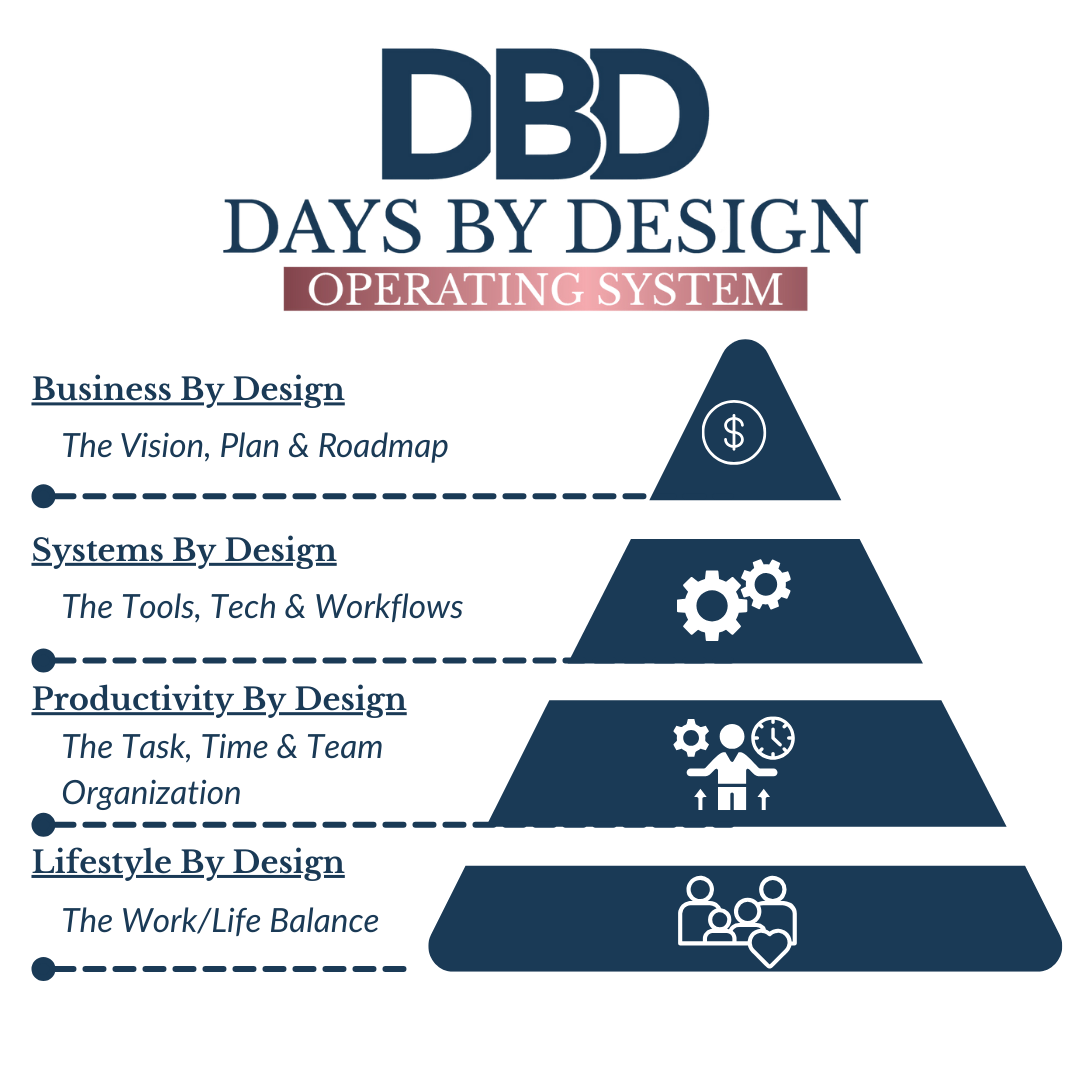
How Days By Design Operating System™ Creates Workspace Clarity
The Days By Design Operating System™ begins by helping founders redesign the environment where work happens.
We evaluate:
Physical workspace.
Digital workspace.
Technology tools.
Browser organization.
Email systems.
File storage.
Calendar structure.
Daily routines.
The goal is simple:
Create a business environment that supports growth instead of creating friction.
Because scaling is not just about adding more.
Sometimes scaling starts with removing what is slowing you down.
Your company does not need more chaos.
It needs an operating environment designed for the next level.
Book a call or send me a DM to learn more.