Your Company Has Outgrown Its Founder: How To Build Systems That Support The Next Stage Of Growth
There is a moment every successful founder eventually experiences.
The business is growing. Revenue is increasing. The team is expanding. Customers are happy.
From the outside, everything looks like it is working.
But internally? Something feels heavier.
The founder is working more hours than ever. Every decision feels important. Every question feels urgent. Every problem seems to find its way back to leadership.
The company is successful. But the founder feels trapped.
This is one of the most misunderstood stages of growth. The business did not fail. The founder did not lose their ability. The company simply reached a point where the systems that created success are no longer strong enough to support the next level.
The company has outgrown the way it operates. And that is actually a good sign.
Growth reveals what needs to evolve.
The question is not: “How do I keep doing everything better?”
The question is: “What needs to change so the business can operate at a higher level?”
That is where operational systems become the difference between a company that grows and a company that breaks under its own success.
The Founder Bottleneck Is Usually Invisible
Most founders do not wake up and decide: “I want to become the bottleneck.” It happens gradually.
A team member asks a question. The founder answers.
A client needs something unusual. The founder steps in.
A process is unclear. The founder fixes it.
A decision needs to be made. The founder approves it.
Over time, the founder becomes the company’s operating system. The business runs because the founder remembers:
- How things work.
- What clients need.
- What decisions were made.
- Where information lives.
- What exceptions exist.
- Who owns what.
This feels valuable because it demonstrates leadership. But eventually, it creates dependency. The company is no longer powered by systems. It is powered by one person’s capacity.
And one person’s capacity has a limit.
The Shift From Founder-Led To System-Led
The biggest transition in business growth is moving from founder-led operations to system-led operations. This does not mean removing the founder. It means changing the founder’s role.
Early-stage founders are often responsible for execution: They sell. They deliver. They solve. They manage. They create.
Growth-stage founders need to focus on: Direction. Strategy. Leadership. Innovation. Relationships. Decision-making.
The founder’s job is not to be involved in everything.
The founder’s job is to design an organization where the right things happen without requiring constant intervention.
That requires systems.
The Seven Systems Every Growing Company Needs
A scalable company is built through connected systems.
Not isolated improvements.
Every part of the business impacts another.
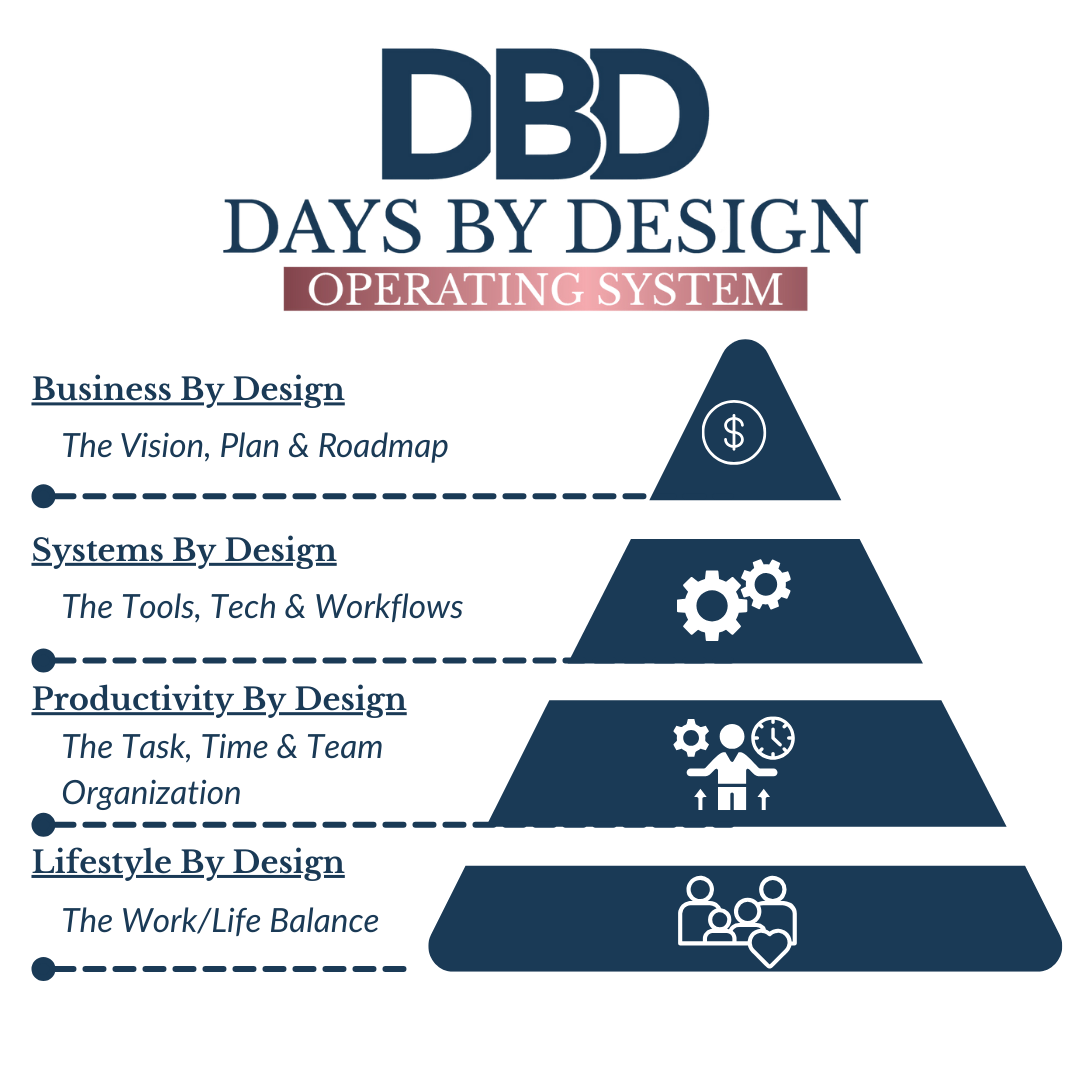
The Days By Design Operating System™ focuses on seven critical operational areas.
1. Physical & Digital Workspace Systems
Your environment impacts your ability to lead.
A chaotic workspace creates unnecessary friction. A scattered digital environment creates wasted time.
Companies need intentional systems for:
- File organization
- Notes organization
- Technology usage.
- Email management.
- Calendar structure.
- Daily routines.
The goal is creating an environment where work can happen efficiently.
2. Task Management Systems
A company cannot scale when work lives in conversations. Tasks need:
- Clear ownership.
- Defined priorities.
- Visible progress.
- Consistent follow-up.
Without a task system, founders become the reminder system. Every question comes back. Every deadline requires checking. Every project requires oversight.
A strong (and simplified) task management system creates independence.
3. Operations Manual Systems
Knowledge trapped inside people creates risk. A scalable company needs a source of truth.
An operations manual should capture:
- Processes.
- Standards.
- Expectations.
- Training.
- Decision-making frameworks.
The goal is not creating documentation nobody reads. The goal is preserving the knowledge that makes the company successful.
4. Meeting Systems
Meetings should create movement. They should not compensate for missing systems.
A strong meeting structure defines:
- Why the meeting exists.
- Who needs to attend.
- What decisions need to happen.
- What actions follow.
The goal is better communication, not more communication.
5. Sales Systems
Revenue cannot depend entirely on founder effort. A scalable sales system creates consistency around:
- Lead management.
- Qualification.
- Pipeline movement.
- Follow-up.
- Proposals.
- Contracts.
The founder’s sales expertise should become company knowledge.
6. Client Systems
Exceptional client experiences require intentional design. A client should experience consistency regardless of who serves them.
Strong client systems include:
- Onboarding.
- Communication.
- Fulfillment.
- Quality standards.
- Offboarding.
The goal is protecting the experience while allowing the company to grow.
7. Team Systems
People are the foundation of growth. But great people need great systems.
Team systems create clarity around:
- Hiring.
- Onboarding.
- Training.
- Performance.
- Development.
- Offboarding.
The goal is building an environment where talented people can succeed.
The final piece is connection.
These systems cannot operate independently. Sales impacts onboarding. Onboarding impacts delivery. Delivery impacts client satisfaction. Client satisfaction impacts growth. Growth impacts team structure.
Everything connects. A business is not a collection of departments. It is one operating ecosystem.
The Real Goal Of Systems
Many founders resist systems because they believe systems make companies rigid.
But poorly designed systems create rigidity.
Good systems create freedom.
- They remove unnecessary decisions.
- They eliminate repeated questions.
- They create confidence.
- They allow teams to move faster.
- They protect leadership attention.
The goal is not creating a company where nobody needs the founder. The goal is creating a company where the founder can focus on the things only they can do.
The Founder Evolution
Every founder eventually faces a choice.
Continue being the person who holds everything together.
Or build the structure that allows everything to grow.
The first path creates exhaustion. The second creates scalability.
The transition requires letting go of the belief that being needed everywhere means being valuable. The most valuable leaders are not the ones who solve every problem. They are the ones who create organizations capable of solving problems.
Building The Next Version Of Your Company
Your company is a reflection of the systems behind it. If growth feels chaotic, look at the infrastructure. If your team needs constant direction, look at the processes. If your calendar is overloaded, look at the operating model. If everything depends on you, look at what needs to become a system.
The next level of your business will require a different way of operating.
The Days By Design Operating System™ helps founders create that foundation.
Because sustainable growth is not created through more effort. It is created through intentional design. Your company was built by your vision. Now it needs systems strong enough to carry that vision forward.
Book a call or send me a DM to learn more.